Showing posts with label History. Show all posts

Saturday, January 3, 2009

Christmastime is Here

Yes, our Russian Orthodox friends are just preparing for Christmas. Here is what Lena shares about Christmas in Russia:

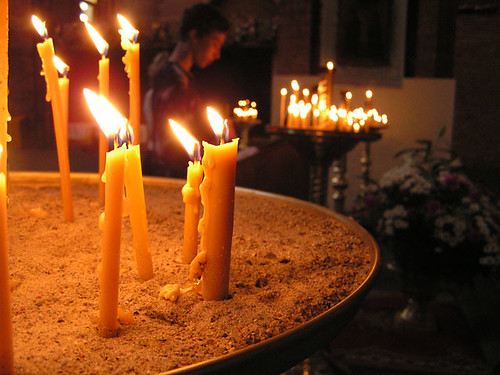
Christmas has an interesting history in Russia. After the 1917 Revolution, Christmas was banned throughout Russia, along with other religious celebrations. It wasn't until 75 years later, in 1992, that the holiday was openly observed. Today, it's once again celebrated in grand fashion, with the faithful participating in an all-night Mass in incense-filled cathedrals and churches.

Christmas in Russia is celebrated on January 7th in accordance with the old Julian calendar. A 40 day Nativity Fast (no meat, no dairy, no sweets) accompanies the preparation for this joyous event. On the Eve of Christmas, it is traditional for all family members to gather to share a special meal to honor the coming of Christ. However, the festivities only begin with the first star appearing in the sky. A lot of the kids from the orphanages go to the Christmas Liturgy service at an Orthodox church on the morning of the 7th. In preparation for Christmas disciplers do a lot of lessons with the kids focused on the meaning and significance of Christmas.


To say “Merry Christmas” in Russian you say “S Rozhdestvom!”

So, we will be feasting in our home next week, in honor of our Russian friends. Please remember the children of Sovietsk this week, when the loss of family can feel especially painful. If you haven't already, you could send a letter. You could donate to keep them warm (see Sock and Glove Drive on the right). You could become a sponsor, the person who sees that he or she is not forgotten. You can pray for their hearts to be warm and light with the love of Christmas Day.

S Rozhdestvom to you and yours!

If you turn your volume up, you will hear Rachmaninoff's Bogoroditse Dievo, a Russian Ave Maria from his Choral Vespers.

Photo Credit: http://farm1.static.flickr.com/39/83066493_d1232b9371.jpg?v=0

Wednesday, December 31, 2008

New Years in Russia

Here is Lena's description of the winter holidays in Russia. Look for her information about Christmas in a later post.

Winter holiday season is one of the most exciting times for everyone in Russia. With the first snow comes first excitement. And as it gets colder and the snow piles grow bigger so does people’s joy and anticipation for winter and everything it brings.

Winter (“zima”) in Russia is a beautiful time and even minus 22 degree Fahrenheit weather can’t take away the feeling of awe when looking at the ice patterns on the windows and snow covered tree branches.

Winter is the time to get skis and sleds out of the closets, go outside, play snowballs and make snowmen.

And, of course, winter is the time to celebrate New Years and Christmas. The tradition for celebrating Christmas is coming back to life, yet New Year’s still remains the biggest winter celebration. The kids in the orphanages, schools and kindergartens start getting ready for New Year’s celebrations a long time in advance. They make New Year’s cards, learn poems about Grandfather Frost and winter and rehearse dances and songs for the big New Year’s performance. From December 30th till January 10th there are winter vacations at school (“kanikuli”). During this time the kids have a lot of parties and celebrations (called “Yolka” - “New Year’s tree”). New Years tree/Christmas tree is the center piece of a lot of places during this season: town squares, shops, work places, homes, school and orphanage auditoriums. Very often it is decorated with the things the kids make themselves: snow flakes, stars, snowman figures etc. The top of the tree is usually decorated with a big star. The New Year’s trees are put up at the end of December and put down in the middle of January.

The two main characters that make their appearance during the New Years season are Grandfather Frost (“Ded Moroz”) and Snow Girl (“Snegurochka”). The Grandfather Frost has replaced in Russia the European Saint Nicolas and American Santa Clause. It is a tall old man with a long white beard in a red fur coat, special mittens, felt boots, with a magic staff and bag of gifts for children. He isn’t carried by reindeer, but rides a big Russian sled with three horses and a little bell under an arch. His usual place of stay is winter snow forest, where he is responsible for blizzards and snow storms.

Snow Girl is his charming granddaughter. She is dressed in a light-blue coat and a hat with white fur and she is also wearing white boots. She has a long blond braid. She is a mistress for birds and animals of a winter forest: hares, squirrels and birds.

Both Grandfather Frost and Snow Girl are the main characters of every “Yolka” celebration. They come to every school, kindergarten, orphanage to give the kids gifts and celebrate with them (very often the characters are played by the orphanage/school staff). During the play malicious Baba Yaga and Forest Man (“Leshiy”) steal the bag with gifts from Ded Moroz. In course of the play the kids help to look for it. Once the bag is found Ded Moroz lights up the New Years tree and does a dance (“horovod”) around it with all the kids and other characters. Many kids are dressed up as fairy tale or winter characters on this day as well: snowflakes, hares, snowmen…

New Years is a family holiday in Russia when all the family gets together at a table for a big New Year’s meal. This happens on the night of the 31st of December. By doing this people say good-bye to the Old Year and welcome the New. The classical attributes for a New Years table are: champagne for adults (though Russians have come up with what’s called “Champagne for Children”--a non alcoholic beverage), tangerines and a meat salad. There are a lot of special programs and shows on TV that night and so the family usually enjoys a big dinner watching TV most of the night. Minutes before midnight the President appears on TV with his New Year’s speech and then the count down begins. Once the Kremlin clock starts to strike midnight people clink their glasses, tell each other “S Novim Godom!” (Happy New Years!) and drink champagne. Another famous New Years tradition is watching the movie called “Irony of Fate” (or “Have a Nice Bath”). It is a hilarious New Year’s movie and it gives a good insight into Russian culture. Directed by Eldar Ryazanov and originally released in 1975, it’s been a tradition to watch the movie on New Year’s or around that time (if you are interested in Russian culture it is a great movie to watch and every Russian would know what you are talking about). Some people who are not into a quiet dinner have New Years parties with dancing, jumping into the snow and sliding down snowy hills at night.

It is customary to exchange gifts on New Years and not on Christmas. People put the gifts under the New Year’s tree and open them right after midnight or in the morning. January 1st is the day of rest, finishing food from last night and quiet family time.

The kids at the orphanages have a big “Yolka” celebration somewhere at the very end of December (29th, 30th) and then usually have a nice dinner and dancing for the actual New Years. But both New Years and Christmas are family holidays so in spite of all the joy and excitement of this season the kids still long for the family touch. Please, send your children a special greeting this Christmas and New Years and let them know that the are loved and remembered.

To say “Happy New Years” you say “S Novim Godom!”

Tuesday, November 11, 2008

History, Part II


In a previous post I highlighted the causes behind the high rate of parent-less children in Russia today. I wrote that the main factors contributing to this issue were Soviet family policy, wars, forced collectivization, and starvation. Now for some more background on how family policy evolved, especially in the early Stalin years.

By the beginning of the 1930s, the Soviet Union's leaders could see that its family policy was having an undesirable effect on the country's social fabric. It was especially disturbing to the government because of the need for young people to fulfill demands for military service and industrial jobs. A campaign of propaganda promoting family values and familial stability was begun that labeled the former policy of easy divorces as "free love," which they considered to be a "bourgeois invention."

The Soviet government began a retrenchment in reaction to its previous policies. In 1936, abortion became illegal in most cases. A government program to build childcare facilities was put into effect. Wedding ceremonies were turned into more solemn occasions. Beginning in 1944, a divorce could only be granted after a court hearing. And inheritance law was reformed so that children could inherit an apartment, a dacha, or other property from his or her parents. The notion of an "illegitimate" child was brought back through a policy that made such inheritance impossible if a child was born to an unregistered marriage. So, in effect, the bourgeois model of the family was restored and by implication, the model of the Marxist family was shown to be untenable in reality.
But, that was then and this is now. More to come.

Friday, October 24, 2008

History, Part I

We think it's important to speak from a broad perspective as to why there are so many orphaned children in Russia and why their circumstances are so dire. So, to add a little bit of historical perspective to the current dilemma, here goes...


The Marxist philosophy of politics and economics, to which Lenin and his comrades adhered at least in the beginning, extended to family life. Under Marxism, gender roles are considered hypocritical. Tasks that were put on women's shoulders in Imperial Russia were, in an ideal socialist society, given over to the public. So things like cleaning, cooking, and childcare would be carried out as a sort of co-op.


What happened in the Soviet Union as a result of applying this bit of Marxism really caused some trouble. According to Marx, marriage and family are unnecessary and so divorce becomes very easy. A piece of Soviet legislation called the Family Code of 1926 attempted to make these practices into law. Civil marriage replaced religious marriage and a divorce could be obtained simply by informing the other partner. As a result, during the 1920s divorce was on the rise in the Soviet Union. By 1926 the divorce rate was at about 50 percent.


The impact of this sharp rise in broken families meant that the state had to look after the children who were abandoned by these dissolved marriages. In the first two decades of the Soviet Union's existence the streets of cities and towns throughout the country were flushed with hundreds of thousands of orphaned and abandoned children.


The sudden appearance of so many orphaned children cannot solely be blamed on the Family Code of 1926; most of the responsibility should be shared by the civil war (1918-1921) and the forced collectivization of farms that took place under Stalin in the 1930s. These two events devastated the population through death by war, disease, and starvation. Some of the children living on the streets were taken into state-run orphanages, most of which were poorly provisioned. Others became the foster children of farming families where they worked as agricultural laborers--an exploitative situation for most kids, no doubt.


For further reading, I would suggest Geoffrey Hosking's Russia and the Russians: A History

Check back later for Part II...